Cat Baby in the Hat the Cat in the Hat Hat Drawing
 Book cover | |
| Author | Dr. Seuss |
|---|---|
| Land | United States |
| Linguistic communication | English |
| Genre | Children's literature |
| Publisher | Random House, Houghton Mifflin |
| Publication engagement | March 12, 1957 |
| Pages | 61 |
| ISBN | 978-0-7172-6059-1 |
| OCLC | 304833 |
| Preceded by | If I Ran the Circus |
| Followed by | How the Grinch Stole Christmas! The Cat in the Hat Comes Dorsum (plot wise) |
The True cat in the Hat is a 1957 children's book written and illustrated by the American author Theodor Geisel, using the pen name Dr. Seuss. The story centers on a tall anthropomorphic cat who wears a red and white-striped top hat and a ruby bow necktie. The Cat shows upwardly at the house of Sally and her brother 1 rainy day when their mother is away. Despite the repeated objections of the children'southward fish, the Cat shows the children a few of his tricks in an endeavour to entertain them. In the procedure, he and his companions, Thing One and Thing Ii, wreck the house. As the children and the fish become more than alarmed, the Cat produces a machine that he uses to clean everything up and disappears merely before the children's female parent comes dwelling.
Geisel created the volume in response to a debate in the U.s.a. about literacy in early on childhood and the ineffectiveness of traditional primers such as those featuring Dick and Jane. Geisel was asked to write a more entertaining primer by William Spaulding, whom he had met during Earth War II and who was and then director of the education division at Houghton Mifflin. However, because Geisel was already nether contract with Random House, the two publishers agreed to a bargain: Houghton Mifflin published the education edition, which was sold to schools, and Random House published the trade edition, which was sold in bookstores.
Geisel gave varying accounts of how he created The Cat in the Hat, but in the version he told most often, he was then frustrated with the word listing from which he could choose words to write his story that he decided to browse the listing and create a story based on the first two rhyming words he found. The words he plant were cat and lid. The book was met with firsthand disquisitional and commercial success. Reviewers praised it as an exciting alternative to traditional primers. Three years after its debut, the volume had already sold over a million copies, and in 2001, Publishers Weekly listed the volume at number nine on its list of acknowledged children'south books of all time. The volume'southward success led to the creation of Beginner Books, a publishing house centered on producing like books for immature children learning to read. In 1983, Geisel said, "It is the book I'm proudest of because information technology had something to do with the death of the Dick and Jane primers." Since its publication, The Cat in the Hat has become one of Dr Seuss's most famous books, with the Cat himself condign his signature creation. The book was adapted into a 1971 animated tv set special and a 2003 live-activity flick, and the Cat has been included in many Dr. Seuss media.
Plot [edit]
The story begins as an unnamed boy who is the narrator of the book sits alone with his sister Emerge in their house on a cold and rainy day, staring wistfully out the window. Then they hear a loud bump which is speedily followed by the arrival of the Cat in the Hat, a tall anthropomorphic cat in a crimson and white-striped meridian hat and a red bow tie, who proposes to entertain the children with some tricks that he knows. The children's pet fish refuses, insisting that the Cat should leave. The Cat then responds by balancing the fish on the tip of his umbrella. The game quickly becomes increasingly trickier, every bit the True cat balances himself on a ball and tries to residue many household items on his limbs until he falls on his head, dropping everything he was belongings. The fish admonishes him once again, only the True cat in the Hat simply proposes another game.
The Cat brings in a big red box from exterior, from which he releases two identical characters, or "Things" as he refers them to, with blue pilus and ruddy suits called Thing One and Affair 2. The Things crusade more trouble, such as flying kites in the house, knocking pictures off the wall and picking up the children'due south mother'southward new polka-dotted clothes. All this comes to an terminate when the fish spots the children's mother out the window. In response, the boy catches the Things in a cyberspace and the Cat, apparently ashamed, stores them back in the large red box. He takes it out the front door equally the fish and the children survey the mess he has made. Only the True cat presently returns, riding a machine that picks everything up and cleans the house, delighting the fish and the children. The Cat and so leaves just before their mother arrives, and the fish and the children are back where they started at the start of the story. As she steps in, the mother asks the children what they did while she was out, but the children are hesitant and do not answer. The story ends with the question, "What would you do if your female parent asked you?"
Background [edit]

An article by John Hersey nigh literacy in early childhood provided inspiration for The Cat in the Hat.
Theodor Geisel, writing as Dr. Seuss, created The True cat in the Hat partly in response to the May 24, 1954, Life magazine article by John Hersey titled "Why Do Students Bog Downwardly on First R? A Local Committee Sheds Lite on a National Problem: Reading".[1] [2] In the article, Hersey was critical of schoolhouse primers like those featuring Dick and Jane:
In the classroom boys and girls are confronted with books that accept insipid illustrations depicting the slicked-up lives of other children... All characteristic abnormally courteous, unnaturally clean boys and girls.... In bookstores anyone can purchase brighter, livelier books featuring strange and wonderful animals and children who behave naturally, i.eastward., sometimes misbehave... Given incentive from school boards, publishers could do every bit well with primers.[3]
Later on detailing many problems contributing to the dilemma connected with educatee reading levels, Hersey asked toward the terminate of the article:
Why should [school primers] not have pictures that widen rather than narrow the associative richness the children give to the words they illustrate—drawings similar those of the wonderfully imaginative geniuses amidst children's illustrators, Tenniel, Howard Pyle, "Dr. Seuss", Walt Disney?[four]
This article defenseless the attention of William Spaulding, who had met Geisel during the war and who was then the director of Houghton Mifflin's education division.[5] Spaulding had also read the best-selling 1955 book Why Johnny Can't Read by Rudolf Flesch.[six] Flesch, like Hersey, criticized primers equally boring only also criticized them for teaching reading through word recognition rather than phonics.[7] In 1955, Spaulding invited Geisel to dinner in Boston where he proposed that Geisel create a book "for vi- and seven-yr-olds who had already mastered the basic mechanics of reading".[5] He reportedly challenged, "Write me a story that first-graders can't put down!"[5]
At the back of Why Johnny Can't Read, Flesch had included 72 lists of words that young children should exist able to read, and Spaulding provided Geisel with a similar list.[7] Geisel later told biographers Judith and Neil Morgan that Spaulding had supplied him with a list of 348 words that every vi-year-old should know and insisted that the book's vocabulary be limited to 225 words.[5] However, co-ordinate to Philip Nel, Geisel gave varying numbers in interviews from 1964 to 1969.[8] He variously claimed that he could utilize between 200 and 250 words from a list of between 300 and 400; the finished book contains 236 different words.[8]
Cosmos [edit]
Geisel gave varying accounts of how he conceived of The Cat in the Chapeau. Co-ordinate to the story Geisel told most oft, he was and then frustrated with the word list that William Spaulding had given him that he finally decided to scan the list and create a story out of the first two words he constitute that rhymed. The words he found were cat and hat.[viii] Near the stop of his life, Geisel told his biographers, Judith and Neil Morgan, that he conceived the ancestry of the story while he was with Spaulding, in an elevator in the Houghton Mifflin offices in Boston.[9] It was an onetime, shuddering elevator and was operated by a "small, stooped adult female wearing 'a leather half-glove and a hush-hush smile'".[9] Anita Silvey, recounting a similar story, described the adult female as "a very elegant, very petite African-American woman named Annie Williams".[10] Geisel told Silvey that, when he sketched the Cat in the Hat, he thought of Williams and gave the character Williams' white gloves and "sly, even foxy smile".[10]

Co-ordinate to Geisel, i of the stories he pitched before The True cat in the Hat involved scaling Mount Everest.
Geisel gave two conflicting, partly fictionalized accounts of the book'south cosmos in 2 articles, "How Orlo Got His Volume" in The New York Times Book Review and "My Hassle with the First Grade Language" in the Chicago Tribune, both published on Nov 17, 1957.[8] In "My Hassle with the Start Grade Language", he wrote most his proposal to a "distinguished schoolbook publisher" to write a book for immature children about "scaling the peaks of Everest at 60 degrees below".[11] The publisher was intrigued but informed him that, because of the word list, "y'all can't utilize the word scaling. You can't use the word peaks. You can't use Everest. You lot can't utilize lx. You tin can't use degrees. Y'all tin't..."[11] Geisel gave a similar business relationship to Robert Cahn for an article in the July half dozen, 1957, edition of The Sat Evening Post.[8] In "My Hassle With the First Form Language", he too told a story of the "three excruciatingly painful weeks" in which he worked on a story near a King Cat and a Queen True cat.[12] Notwithstanding, "queen" was non on the word list, nor did his get-go grade nephew, Norval, recognize it. So Geisel returned to the work merely could so recollect only of words that started with the alphabetic character "q", which did not appear in any give-and-take on the list. He then had a like fascination with the letter of the alphabet "z", which also did not appear in any word on the list. When he did finally finish the book and showed it to his nephew, Norval had already graduated from the showtime grade and was learning calculus. Philip Nel notes, in his autopsy of the article, that Norval was Geisel's invention. Geisel's niece, Peggy Owens, did have a son, but he was simply a one-year-erstwhile when the article was published.[13]
In "How Orlo Got His Book", he described Orlo, a fictional, archetypal young child who was turned off of reading past the poor selection of simple reading textile.[14] To relieve Orlo the frustration, Geisel decided to write a book for children like Orlo merely found the task "not dissimilar to... being lost with a witch in a tunnel of dear".[14] He tried to write a story chosen "The Queen Zebra" simply found that both words did not appear on the list. In fact, similar Geisel wrote in "My Hassle with the Start Grade Linguistic communication", the messages "q" and "z" did not appear on the list at all. He then tried to write a story most a bird, without using the word bird as it did not appear on the list. He decided to call it a "fly thing" instead but struggled every bit he discovered that it "couldn't have legs or a beak or a tail. Neither a left foot or a right pes."[xv] On his approach to writing The Cat in the Lid he wrote, "The method I used is the same method you utilize when you sit down to make apple tree stroodle [sic] without stroodles."[fifteen]
Geisel variously stated that the volume took between ix and eighteen months to create.[xvi] Donald Pease notes that he worked on it primarily lone, different with previous books, which had been more collaborative efforts between Geisel and his wife, Helen.[17] This marked a general trend in his work and life. As Robert L. Bernstein later said of that period, "The more than I saw of him, the more he liked being in that room and creating all by himself."[xviii] Pease points to Helen's recovery from Guillain–Barré syndrome, which she was diagnosed with in 1954, as the marking for this modify.[18]
Publication history [edit]

Bennett Cerf (pictured in 1932), the head of Random House, negotiated a deal that allowed both Random House and Houghton Mifflin to publish versions of The True cat in the Hat.
Geisel agreed to write The True cat in the Lid at the request of William Spaulding of Houghton Mifflin; all the same, considering Geisel was under contract with Random Firm, the head of Random House, Bennett Cerf, made a bargain with Houghton Mifflin. Random House retained the rights to merchandise sales, which encompassed copies of the book sold at volume stores, while Houghton Mifflin retained the education rights, which encompassed copies sold to schools.[5]
The Houghton Mifflin edition was released in January or February 1957, and the Random House edition was released on March i.[xix] The two editions featured different covers but were otherwise identical.[19] The showtime edition tin can exist identified past the "200/200" mark in the top right corner of the front dust jacket flap, signifying the $ii.00 selling cost. The price was reduced to $1.95 on afterward editions.[20]
According to Judith and Neil Morgan, the book sold well immediately. The trade edition initially sold an average of 12,000 copies a month, a figure which rose rapidly.[21] Bullock'south department store in Los Angeles, California, sold out of its first, 100-copy order of the book in a twenty-four hour period and rapidly reordered 250 more.[21] The Morgans attribute these sales numbers to "playground word-of-mouth", asserting that children heard about the volume from their friends and nagged their parents to purchase it for them.[21] However, Houghton Mifflin's school edition did not sell as well. As Geisel noted in Jonathan Cott'due south 1983 profile of him, "Houghton Mifflin... had trouble selling information technology to the schools; at that place were a lot of Dick and Jane devotees, and my book was considered too fresh and irreverent. Just Bennett Cerf at Random Firm had asked for merchandise rights, and it only took off in the bookstores."[22] Geisel told the Morgans, "Parents understood ameliorate than school people the necessity for this kind of reader."[21]
Later on iii years in impress, The Cat in the Chapeau had sold nearly one million copies. Past and then, the book had been translated into French, Chinese, Swedish, and Braille.[21] In 2001, Publishers Weekly placed it at number nine on its listing of the best-selling children'due south books of all fourth dimension.[23] Equally of 2007, more than than x million copies of The Cat in the Hat have been printed, and it has been translated into more than 12 different languages, including Latin, under the title Cattus Petasatus.[24] [25] In 2007, on the occasion of the book's fiftieth anniversary, Random House released The Annotated Cat: Under the Hats of Seuss and His Cats, which includes both The Cat in the Hat and its sequel, with annotations and an introduction by Philip Nel.[19]
Reception [edit]
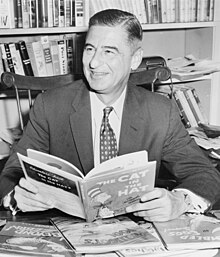
Geisel in 1957, holding a copy of The True cat in the Chapeau
The book was published to immediate critical acclaim. Some reviewers praised the volume as an exciting way to learn to read, specially compared to the primers that it supplanted. Ellen Lewis Buell, in her review for The New York Times Book Review, noted the book'due south heavy apply of one-syllable words and lively illustrations.[26] She wrote, "Beginning readers and parents who have been helping them through the dreary activities of Dick and Jane and other primer characters are due for a happy surprise."[27] Helen Adams Masten of the Saturday Review called the volume Geisel's bout de force and wrote, "Parents and teachers will anoint Mr. Geisel for this amusing reader with its ridiculous and lively drawings, for their children are going to take the exciting experience of learning that they can read afterwards all."[28] Polly Goodwin of the Chicago Sunday Tribune predicted that The True cat in the Hat would cause 7- and 8-year-olds to "look with distinct distaste on the drab adventures of standard primer characters".[29]
Both Helen E. Walker of Library Journal and Emily Maxwell of The New Yorker felt that the book would appeal to older children also as to its target audition of beginning- and 2d-graders.[30] The reviewer for The Bookmark concurred, writing, "Recommended enthusiastically as a picture book likewise as a reader".[31] In contrast, Heloise P. Mailloux wrote in The Horn Book Magazine, "This is a fine book for remedial purposes, but self-conscious children ofttimes refuse fabric if its seems meant for younger children."[32] She felt that the volume's limited vocabulary kept it from reaching "the cool excellence of early Seuss books".[32]
Based on a 2007 online poll, the National Education Clan listed The Cat in the Hat as one of its "Teachers' Top 100 Books for Children".[33] In 2012, information technology was ranked number 36 amid the "Top 100 Picture Books" in a survey published past School Library Periodical – the third of v Dr. Seuss books on the list.[34] It was awarded the Early on Readers BILBY Award in 2004 and 2012.[35]
The volume's fiftieth anniversary in 2007 prompted a reevaluation of the book from some critics. Yvonne Coppard, reviewing the fiftieth anniversary edition in Carousel magazine, wondered if the popularity of the Cat and his "delicious naughty behavior" will endure another fifty years. Coppard wrote, "The innocent ignorance of bygone days has given style to an all-embracing, nigh paranoid sensation of kid protection issues. And here nosotros have the mysterious stranger who comes in, uninvited, while your mother is out."[36]
Assay [edit]
Philip Nel places the book'due south title character in the tradition of con artists in American art, including the title characters from Meredith Willson's The Music Man and L. Frank Baum's The Wonderful Sorcerer of Oz.[37] Nel also contends that Geisel identified with the True cat, pointing to a cocky portrait of Geisel in which he appears every bit the Cat, which was published alongside a profile nigh him in The Sabbatum Evening Post on July 6, 1957.[37] Michael K. Frith, who worked equally Geisel'south editor, concurs, arguing that "The True cat in the Chapeau and Ted Geisel were inseparable and the same. I think in that location'south no question about it. This is someone who delighted in the chaos of life, who delighted in the seeming insanity of the world around him."[37] Ruth MacDonald asserts that the True cat'due south primary goal in the volume is to create fun for the children. The Cat calls information technology "fun that is funny", which MacDonald distinguishes from the ordinary, serious fun that parents discipline their children to.[38] In an article titled "Was the Cat in the Lid Blackness?", Philip Nel draws connections between the Cat and stereotyped depictions of African-Americans, including minstrel shows, Geisel's own minstrel-inspired cartoons from early on in his career, and the use of the term "cat" to refer to jazz musicians.[39] [twoscore] According to Nel, "Even every bit [Geisel] wrote books designed to challenge prejudice, he never fully shed the cultural assumptions he grew upwards with, and was likely unaware of the means in which his visual imagination replicated the racial ideologies he consciously sought to decline."[39]
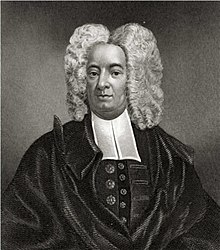
Geisel once called the fish in The True cat in the Hat "my version of Cotton Mather".
Geisel one time called the fish "my version of Cotton wool Mather", the Puritan moralist who advised the prosecutors during the Salem witch trials.[41] Betty Mensch and Alan Freeman back up this view, writing, "Drawing on old Christian symbolism (the fish was an aboriginal sign of Christianity) Dr. Seuss portrays the fish as a kind of ever-nagging superego, the embodiment of utterly conventionalized morality."[41] Philip Nel notes that other critics take likewise compared the fish to the superego. Anna Quindlen chosen the Cat "pure id" and marked the children, as mediators between the Cat and the fish, as the ego.[41] Mensch and Freeman, all the same, argue that the Cat shows elements of both id and ego.[41]
In her analysis of the fish, MacDonald asserts that it represents the voice of the children'southward absent mother.[42] Its conflict with the Cat, not merely over the Cat's uninvited presence but as well their inherent predator-casualty relationship, provides the tension of the story. She points out that on the concluding page, while the children are hesitant to tell their female parent about what happened in her absence, the fish gives a knowing look to the readers to assure them "that something did go along but that silence is the better office of valor in this case".[42] Alison Lurie agrees, writing, "there is a strong suggestion that they might not tell her."[43] She argues that, in the Cat'south destruction of the house, "the kids—and not only those in the story, but those who read it—have vicariously given full rein to their destructive impulses without guilt or consequences."[43] For a 1983 article, Geisel told Jonathan Cott, "The Cat in the Hat is a revolt against authorisation, simply it'south ameliorated by the fact that the True cat cleans up everything at the end. It's revolutionary in that it goes as far as Kerensky and so stops. Information technology doesn't go quite as far every bit Lenin."[44]
Donald Pease notes that The Cat in the Hat shares some structural similarities with other Dr. Seuss books. Similar earlier books, The Cat in the Chapeau starts with "a child'due south feeling of discontent with his mundane circumstances" which is shortly enhanced by make believe.[45] The book starts in a factual, realistic world, which crosses over into the world of brand believe with the loud bump that heralds the arrival of the True cat.[45] Even so, this is the offset Dr. Seuss book in which the fantasy characters, i.east. the True cat and his companions, are not products of the children's imagination.[45] It likewise differs from previous books in that Sally and her brother actively participate in the fantasy world; they also accept a changed opinion of the Cat and his globe by the story's cease.[45]
Legacy [edit]
Ruth MacDonald asserts, "The Cat in the Chapeau is the book that fabricated Dr. Seuss famous. Without The True cat, Seuss would accept remained a pocket-sized calorie-free in the history of children'southward literature."[46] Donald Pease concurs, writing, "The True cat in the Chapeau is the archetype in the archive of Dr. Seuss stories for which information technology serves as a cornerstone and a linchpin. Before writing it Geisel was improve known for the 'Quick, Henry, the Flit!' ad entrada than for his ix children's books."[47] The publication and popularity of the book thrust Geisel into the heart of the The states literacy debate, what Pease chosen "the nearly important bookish controversy" of the Cold War era.[47] Academic Louis Menand contends that "The Cat in the Chapeau transformed the nature of primary education and the nature of children's books. It not only stood for the idea that reading ought to be taught past phonics; it also stood for the idea that language skills—and many other subjects—ought to be taught through illustrated storybooks, rather than primers and textbooks."[48] In 1983, Geisel told Jonathan Cott, "It is the book I'k proudest of because information technology had something to do with the death of the Dick and Jane primers."[22]

A Cat in the Chapeau Christmas decoration in the White House, 2003
The book led directly to the cosmos of Beginner Books, a publishing firm centered on producing books like The Cat in the Chapeau for beginning readers.[21] According to Judith and Neil Morgan, when the volume caught the attention of Phyllis Cerf, the wife of Geisel's publisher, Bennett Cerf, she bundled for a meeting with Geisel, where the ii agreed to create Beginner Books.[21] Geisel became the president and editor, and the Cat in the Chapeau served every bit their mascot. Geisel's wife, Helen, was made 3rd partner. Random House served equally benefactor[21] until 1960, when Random Firm purchased Beginner Books.[49] Geisel wrote multiple books for the series, including The Cat in the Lid Comes Dorsum (1958), Green Eggs and Ham (1960), Hop on Pop (1963), and Fox in Socks (1965).[l] He initially used discussion lists of limited vocabularies to create these books, as he had with The Cat in the Lid, but moved away from the lists every bit he came to believe "that a child could larn any corporeality of words if fed them slowly and if the books were amply illustrated".[51] Other authors likewise contributed notable books to the series, including A Fly Went By (1958), Sam and the Firefly (1958), Go, Dog. Go! (1961), and The Big Honey Hunt (1962).[fifty]
The book, or elements of it, has been mentioned multiple times in United States politics. The image of the Cat balancing many objects on his trunk while in turn balancing himself on a ball has been included in political cartoons and articles. Political caricaturists have portrayed both Bill Clinton and George W. Bush in this way.[52] In 2004, MAD mag published "The Strange Similarities Between the Bush Administration and the World of Dr. Seuss", an commodity which matched quotes from White House officials to excerpts taken from Dr. Seuss books, and in which George W. Bush-league'south State of the Union promises were contrasted with the Cat vowing (in part), "I can concord up the cup and the milk and the block! I can concord up these books! And the fish on a rake!"[53] In 2007, during the 110th Congress, Senate Bulk Leader Harry Reid compared the impasse over a neb to reform clearing with the mess created by the Cat. He read lines of the volume from the Senate floor.[54] He then carried forward his analogy hoping the impasse would be straightened out for "If you go back and read Dr. Seuss, the cat manages to make clean up the mess."[55] In 1999, the United states Post issued a postage featuring the True cat in the Chapeau.[56]
The Cat in the Hat 'south popularity too led to increased popularity and exposure for Geisel's previous children's books. For case, 1940's Horton Hatches the Egg had sold 5,801 copies in its opening year and 1,645 the post-obit year. In 1958, the twelvemonth after the publication of The Cat in the Chapeau, 27,643 copies of Horton were sold, and by 1960 the volume had sold a total of over 200,000 copies.[47]
In 2020, The Cat in the Hat placed second on the New York Public Library's list of "Meridian ten Checkouts of All Time".[57] [58]
Adaptations [edit]
The Cat in the Hat has been adapted for various media, including theater, television receiver, and picture.
Blithe Tv special [edit]
The True cat in the Hat is an animated musical Tv set special which premiered in 1971 and starred Allan Sherman as the Cat. In 1973 Sherman reprised the role for Dr. Seuss on the Loose, where the Cat host three stories, and information technology was his final projection before his death that aforementioned year.
Television set [edit]
The Cat is the host of The Wubbulous World of Dr. Seuss, an American puppet series that premiered on October 13, 1996 and ended on December 28, 1998. His chaotic and messy personae from the original Cat in the Hat book has been noticeably toned down, portraying him as more of an all-seeing trickster narrating, and helping other characters in, stories from around Seussville. The character was performed by Bruce Lanoil in the show'south starting time season, with Martin P. Robinson taking over in season 2. Instead of Thing 1 and Thing Two from the original story, the Cat is commonly seen in the visitor of Little Cats A, B and C from Comes Back.
The Cat in the Hat Knows a Lot Near That! is a British-Canadian-American animated television serial that premiered on Baronial 7, 2010, and ended on October fourteen, 2018. It starred Martin Brusk as the phonation of the True cat. The Cat in this series is portrayed as a genuinely wise, but still adventurous, guide to Sally and Nick (who replaced her brother Conrad).
Live-activeness movie [edit]
In 2003, The Cat in the Hat, a live-action picture adaptation, was released, starring Mike Myers every bit the True cat. The film grossed $133,960,541 worldwide on an estimated $109 million budget.[59] Information technology was poorly received by critics and a planned sequel was subsequently cancelled. Due to the film'south failure, Audrey Geisel, Seuss' widow, decided not to allow whatsoever further live-action adaptations of her married man'due south piece of work.
Proposed animated moving picture [edit]
In 2012, following the financial success of The Lorax, an animated film accommodation of The Lorax, Universal Pictures and Illumination Entertainment announced plans to produce a CGI adaptation of The True cat in the Lid.[60] Rob Lieber was set to write the script, with Chris Meledandri every bit producer, and Audrey Geisel as the executive producer. However, the project never came to fruition.[61] On Jan 24, 2018, information technology was announced that Warner Animation Grouping was in development of a different musical animated Cat in the Chapeau film as part of a creative partnership with Seuss Enterprises.[62]
Soviet drawing [edit]
In 1984, the book was adjusted in Russian as a nine-minute cartoon called Кот в колпаке (The Cat in the Cap). The curt omits Thing One and Thing Two, along with changing the Cat'southward hat into a cap; initially an umbrella when it comes in from the rainy street, and making a number of additional transformations throughout the story. Emerge's name is not mentioned, neither is her blood brother Conrad.
PC [edit]
In 1997, the book was made into a Living Books adaption for the PC.[63]
Phase play [edit]
In 2009, the Royal National Theatre created a stage version of the book, adapted and directed past Katie Mitchell.[64] It has since toured the UK and been revived.
Character and themes [edit]
Seussical, a musical adaptation that incorporates aspects of many Dr. Seuss works, features the Cat in the Hat as narrator.[65] The musical received weak reviews when it opened in November 2001 simply eventually became a staple in regional and school theaters.[65]
A ride at Universal Studios' Islands of Adventure park in Orlando, Florida, has a Cat in the Hat theme.[66]
On July 26, 2016, Random House and Dr. Seuss Enterprises announced that the True cat in the Hat was running for US president.[67] [68] [69] [70]
See also [edit]
- Dr. Seuss Memorial
- Grinch
- Horton the Elephant
References [edit]
- ^ O'Brien, Anne. "An Educational Innovation: The Cat in the Chapeau". Learning Showtime Alliance. Archived from the original on 2 Nov 2013. Retrieved viii Nov 2013.
- ^ Nel 2004, p. 29
- ^ Hersey 1954, pp. 136-137
- ^ Hersey 1954, p. 148
- ^ a b c d due east Morgan 1995, pp. 153-154
- ^ Menander 2002, p. 1
- ^ a b Menand 2002, p. 2
- ^ a b c d e Nel 2007, pp. 24-26
- ^ a b Morgan 1995, p. 153
- ^ a b Silvey, Anita (March ane, 2007). "How the Cat Got His Smile". Heed Morning Edition. NPR.
- ^ a b "My Hassle With the Starting time Grade Language" 1957, p. 171
- ^ "My Hassle With the First Grade Language" 1957, p. 173
- ^ "My Hassle With the First Grade Language" 1957, p. 170
- ^ a b "How Orlo Got His Book" 1957, p. 167
- ^ a b "How Orlo Got His Volume" 1957, p. 169
- ^ Nel 2004, p. 30
- ^ Pease 2010, pp. 112–115
- ^ a b Pease 2010, p. 114
- ^ a b c Neary, Lynn. "L Years of 'The Cat in the Lid'". NPR. Retrieved 13 November 2013.
- ^ Nel 2007, p. xx
- ^ a b c d e f g h Morgan 1995, pp. 156–157
- ^ a b Cott 1983, p. 115
- ^ "All-Time Bestselling Children's Books". Publishers Weekly. 17 December 2001. Archived from the original on Dec 25, 2005.
- ^ Horrigan, Kevin. "The Cat at 50: Still lots of practiced fun that is funny". Milwaukee Periodical Sentinel. Archived from the original on 24 February 2009. Retrieved 22 Nov 2013.
- ^ Dr. Seuss; Jennifer Morrish Tunberg; Terence Tunberg (2000). Cattus petasatus: The cat in the hat in Latin (in Latin). Bolchazy-Carducci. p. 75. ISBN9780865164710 . Retrieved 29 Nov 2013.
- ^ Buell, Ellen Lewis (17 March 1957). "Loftier Jinks at Home". The New York Times Book Review, every bit quoted in Fensch 2001, pp. 124–125.
{{cite news}}: CS1 maint: postscript (link) - ^ Buell, Ellen Lewis (17 March 1957). "High Jinks at Abode". The New York Times Book Review, as quoted in Nel 2007, pp. ix–ten.
{{cite news}}: CS1 maint: postscript (link) - ^ Masten, Helen Adams (11 May 1957). "The Cat in the Hat". Saturday Review, equally quoted in Nel 2007, pp. 9–x.
{{cite news}}: CS1 maint: postscript (link) - ^ Goodwin, Polly (12 May 1957). "Hurray for Dr. Seuss!". Chicago Lord's day Tribune. Chicago IL, as quoted in Nel 2007, pp. 9–x.
{{cite news}}: CS1 maint: postscript (link) - ^ Nel 2007, pp. 9–10
- ^ "Some Early Jump Books for Children and Immature People". The Bookmark. Apr 1957, as quoted in Fensch 2001, pp. 124–125
{{cite news}}: CS1 maint: postscript (link) - ^ a b Mailloux, Heloise P. (June 1957). "Late Jump Book List". The Horn Book Mag, equally quoted in Nel 2007, pp. nine–ten.
{{cite news}}: CS1 maint: postscript (link) - ^ National Education Association (2007). "Teachers' Elevation 100 Books for Children". Archived from the original on February 5, 2009. Retrieved Baronial 19, 2012.
- ^ Bird, Elizabeth (July six, 2012). "Elevation 100 Picture Books Poll Results". A Fuse #8 Production. Weblog. Schoolhouse Library Journal (weblog.schoollibraryjournal.com). Archived from the original on December four, 2012. Retrieved August 19, 2012.
- ^ "Previous Winners of the BILBY Awards: 2001 to appointment" (PDF). www.cbcaqld.org. The Children's Book Council of Australia Queensland Co-operative. Archived from the original (PDF) on 19 November 2015. Retrieved 4 Nov 2015.
- ^ Coppard, Yvonne (Fall 2007). "The Cat in the Hat Review". Carousel (37).
- ^ a b c Nel 2004, p. 118-119
- ^ MacDonald 1986, pp. 110–111
- ^ a b Nel, Philip (2014). "Was the Cat in the Chapeau Blackness?: Exploring Dr. Seuss'due south Racial Imagination". Children's Literature. 42 (one): 71–98.
- ^ Kalnay, Erica Kanesaka (2019-09-05). "Was the Cat in the Hat Black?: The Subconscious Racism of Children's Literature, and the Need for Diverse Books by Philip Nel (review)". Children's Literature Clan Quarterly. 44 (three): 336–338. doi:10.1353/chq.2019.0040. ISSN 1553-1201.
- ^ a b c d Nel 2007, twoscore
- ^ a b MacDonald 1986, pp. 114–115
- ^ a b Lurie 1992, p. 70
- ^ Cott 1983, p. 117
- ^ a b c d Pease 2010, pp. 103–105
- ^ MacDonald 1988, p. 105
- ^ a b c Pease 2010, pp. 111–112
- ^ Menand 2002, p. 3
- ^ Morgan 1995, p. 167
- ^ a b "First Edition Beginner Books". 1stedition.net. Retrieved 26 November 2013.
- ^ "Somebody'southward Got to Win" 1986, p. 126
- ^ Nel 2007, p. 48
- ^ MAD Magazine #447, Nov 2004, Drucker/Devlin
- ^ Dana Milbank (June viii, 2007). "Snubbing the White House, Without Snubbing the White Firm". The Washington Mail service.
- ^ Stephen Dinan (June 6, 2007). "Senate tries to cool immigration bill rut". The Washington Times.
- ^ Fensch 2001, p. 176
- ^ New York Public Library. "Acme ten Checkouts of All Time". nypl.org . Retrieved 2020-11-01 .
- ^ "These Are The NYPL'south Meridian Check Outs OF ALL TIME". Archived from the original on 2020-01-13. Retrieved 2020-01-thirteen .
- ^ "Dr. Seuss' The Cat in the Hat". Boxoffice.com. Archived from the original on 3 December 2013. Retrieved 27 November 2013.
- ^ Minovitz, Ethan (March 18, 2012). "The True cat In The Lid comes back equally animated feature". Big Cartoon News. Archived from the original on December 3, 2012. Retrieved March 18, 2012.
- ^ Kit, Borys (January 24, 2018). "New 'True cat in the Lid' Picture in the Works From Warner Bros". The Hollywood Reporter . Retrieved January 24, 2018.
- ^ Kit, Borys (January 24, 2018). "New 'Cat in the Hat' Motion-picture show in the Works From Warner Bros". The Hollywood Reporter . Retrieved March 5, 2018.
- ^ Living Books (1997), Dr Seuss's The True cat in the Hat (Living Books) (1997) , retrieved 2020-12-22
- ^ Spencer, Charles (17 Dec 2009). "The Cat in the Chapeau at the National Theatre, review". The Daily Telegraph. Archived from the original on 2022-01-12. Retrieved 27 November 2013.
- ^ a b Connema, Richard. "Seussical is a Charming Musical". Talkin Broadway. Retrieved 27 Nov 2013.
- ^ "True cat in the Hat at Universal'south Islands of Chance". Orlando Informer . Retrieved i April 2016.
- ^ "The Cat in the Hat announces candidacy for president | Boston.com". www.boston.com . Retrieved 2019-12-20 .
- ^ "Dr. Seuss' True cat in the Hat tosses his chapeau into the 2016 presidential race at Springfield rally (photos)". masslive. 2016-07-26. Retrieved 2019-12-twenty .
- ^ "Cat in the Hat Tosses Red, White and Blue Stovepipe Cap Into Presidential Ring". The Hollywood Reporter . Retrieved 2019-12-twenty .
- ^ Books, Random House Children's. "Dr. Seuss's the True cat in the Hat Tosses Red and White Stovepipe Chapeau in the Ring for 2016 Presidential Election, equally the Kids' Candidate!". world wide web.prnewswire.com . Retrieved 2019-12-20 .
Bibliography [edit]
- Cott, Jonathan (1983). "The Skillful Dr. Seuss". In Fensch, Thomas (ed.). Of Sneetches and Whos and the Good Dr. Seuss: Essays on the Writings and Life of Theodor Geisel. McFarland & Visitor. pp. 99–123. ISBN0-7864-0388-8.
- Fensch, Thomas (2001). The Human Who Was Dr. Seuss . Woodlands: New Century Books. ISBN0-930751-11-six.
- Fensch, Thomas, ed. (April xiv, 1986). "'Somebody'south Got to Win' in Kids' Books: An Interview with Dr. Seuss on His Books for Children, Young and Quondam". Of Sneetches and Whos and the Good Dr. Seuss: Essays on the Writings and Life of Theodor Geisel. McFarland & Visitor. pp. 125–127. ISBN0-7864-0388-viii.
- Hersey, John (24 May 1954). "Why Do Students Bog Down on Outset R?". Life . Retrieved 8 November 2013.
- Lurie, Alison (1992). "The Cabinet of Dr. Seuss". Popular Civilization: An Introductory Text. ISBN978-0-87972-572-3.
- MacDonald, Ruth (1988). Dr. Seuss . Twayne Publishers. ISBN0-8057-7524-2.
- Menand, Louis. "Cat People: What Dr. Seuss Really Taught Us". The New Yorker . Retrieved ix Nov 2013.
- Morgan, Judith; Neil Morgan (1995). Dr. Seuss & Mr. Geisel . Random Business firm. ISBN0-679-41686-ii.
- Nel, Philip (2007). The Annotated Cat: Under the Hats of Seuss And His Cats. New York: Random Firm. ISBN978-0-375-83369-4.
- Nel, Philip (2004). Dr. Seuss: American Icon . Continuum Publishing. ISBN0-8264-1434-6.
- Pease, Donald Due east. (2010). Theodor Seuss Geisel . Oxford University Press. ISBN978-0-19-532302-three.
- Seuss, Dr. (17 November 1957). "How Orlo Got His Book". In Nel, Philip (ed.). The Annotated Cat: Under the Hats of Seuss And His Cats. Random House. pp. 167–169. ISBN978-0-375-83369-four.
- Seuss, Dr. (17 November 1957). "My Hassle With the First Form Language". In Nel, Philip (ed.). The Annotated Cat: Under the Hats of Seuss And His Cats. Random Business firm. pp. 170–173. ISBN978-0-375-83369-4.
fitzgeralddarry1958.blogspot.com
Source: https://en.wikipedia.org/wiki/The_Cat_in_the_Hat
0 Response to "Cat Baby in the Hat the Cat in the Hat Hat Drawing"
Post a Comment