Review the Graph at Right for a Monopoly Market
Market Differences Betwixt Monopoly and Perfect Competition
Monopolies, as opposed to perfectly competitive markets, have high barriers to entry and a single producer that acts as a toll maker.
Learning Objectives
Distinguish between monopolies and competitive firms
Key Takeaways
Primal Points
- In a perfectly competitive market, at that place are many producers and consumers, no barriers to exit and entry into the market, perfectly homogenous goods, perfect information, and well-defined property rights.
- Perfectly competitive producers are cost takers that can choose how much to produce, but non the price at which they can sell their output.
- A monopoly exists when at that place is only ane producer and many consumers.
- Monopolies are characterized by a lack of economic competition to produce the good or service and a lack of viable substitute goods.
Fundamental Terms
- perfect competition: A type of market with many consumers and producers, all of whom are price takers
- network externality: The effect that one user of a good or service has on the value of that production to other people
- perfect data: The assumption that all consumers know all things, about all products, at all times, and therefore always make the best conclusion regarding purchase.
A market can be structured differently depending on the characteristics of contest within that marketplace. At ane extreme is perfect competition. In a perfectly competitive market, in that location are many producers and consumers, no barriers to enter and go out the market place, perfectly homogeneous goods, perfect data, and well-defined property rights. This produces a organisation in which no individual economic actor tin can bear upon the price of a skilful – in other words, producers are price takers that can choose how much to produce, simply not the price at which they can sell their output. In reality there are few industries that are truly perfectly competitive, but some come very close. For example, commodity markets (such equally coal or copper) typically have many buyers and multiple sellers. There are few differences in quality between providers so goods tin be hands substituted, and the goods are uncomplicated enough that both buyers and sellers accept total information nigh the transaction. It is unlikely that a copper producer could raise their prices above the market rate and all the same find a heir-apparent for their product, so sellers are price takers.
A monopoly, on the other hand, exists when there is only one producer and many consumers. Monopolies are characterized by a lack of economical competition to produce the good or service and a lack of viable substitute goods. As a upshot, the single producer has command over the price of a good – in other words, the producer is a price maker that can determine the price level by deciding what quantity of a proficient to produce. Public utility companies tend to be monopolies. In the case of electricity distribution, for example, the cost to put upwardly power lines is so high it is inefficient to take more one provider. There are no good substitutes for electricity commitment so consumers take few options. If the electricity distributor decided to heighten their prices it is likely that almost consumers would keep to purchase electricity, so the seller is a cost maker.
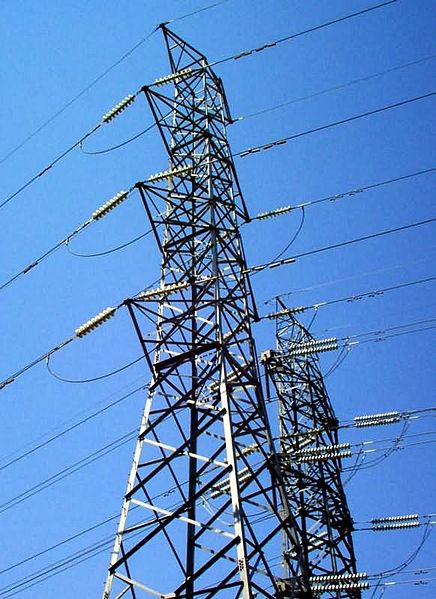
Electricity Distribution: The cost of electrical infrastructure is so expensive that there are few or no competitors for electricity distribution. This creates a monopoly.
Sources of Monopoly Power
Monopoly power comes from markets that have loftier barriers to entry. This can be caused by a variety of factors:
- Increasing returns to scale over a big range of product
- High capital requirements or large research and development costs
- Production requires control over natural resources
- Legal or regulatory barriers to entry
- The presence of a network externality – that is, the use of a product by a person increases the value of that product for other people
Monopoly Vs. Perfect Contest
Monopoly and perfect competition marker the two extremes of market place structures, but there are some similarities between firms in a perfectly competitive market place and monopoly firms. Both face the same cost and production functions, and both seek to maximize profit. The shutdown decisions are the aforementioned, and both are assumed to take perfectly competitive factors markets.
Nevertheless, in that location are several cardinal distinctions. In a perfectly competitive market, price equals marginal cost and firms earn an economic profit of zero. In a monopoly, the price is set up higher up marginal cost and the firm earns a positive economical profit. Perfect contest produces an equilibrium in which the price and quantity of a skillful is economically efficient. Monopolies produce an equilibrium at which the price of a good is higher, and the quantity lower, than is economically efficient. For this reason, governments ofttimes seek to regulate monopolies and encourage increased contest.
Marginal Revenue and Marginal Toll Relationship for Monopoly Production
For monopolies, marginal cost curves are upward sloping and marginal revenues are downward sloping.
Learning Objectives
Analyze how marginal and marginal costs touch a visitor's production conclusion
Key Takeaways
Cardinal Points
- Business firm typically have marginal costs that are depression at low levels of production simply that increase at college levels of product.
- While competitive firms experience marginal revenue that is equal to price – represented graphically by a horizontal line – monopolies have downwardly-sloping marginal revenue curves that are different than the skilful's price.
- For monopolies, marginal revenue is always less than price.
Key Terms
- marginal acquirement: The boosted profit that will exist generated by increasing product sales by one unit.
- marginal cost: The increase in price that accompanies a unit increase in output; the partial derivative of the cost function with respect to output. Additional toll associated with producing one more unit of output.
Turn a profit Maximization
In traditional economics, the goal of a firm is to maximize their profits. This means they want to maximize the divergence between their earnings, i.e. revenue, and their spending, i.east. costs. To notice the profit maximizing bespeak, firms look at marginal revenue (MR) – the total additional revenue from selling 1 additional unit of measurement of output – and the marginal toll (MC) – the total additional price of producing one additional unit of output. When the marginal acquirement of selling a good is greater than the marginal cost of producing it, firms are making a turn a profit on that product. This leads direct into the marginal conclusion rule, which dictates that a given good should continue to be produced if the marginal acquirement of one unit of measurement is greater than its marginal price. Therefore, the maximizing solution involves setting marginal revenue equal to marginal price.
This is relatively straightforward for firms in perfectly competitive markets, in which marginal revenue is the same as cost. Monopoly production, notwithstanding, is complicated by the fact that monopolies accept need curves and MR curves that are singled-out, causing price to differ from marginal revenue.
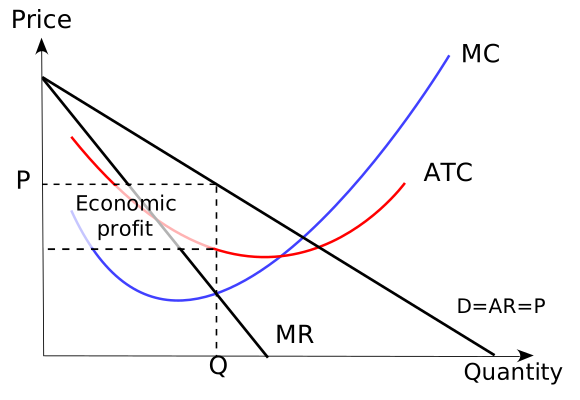
Monopoly: In a monopoly market place, the marginal revenue bend and the need curve are distinct and downward-sloping. Product occurs where marginal cost and marginal acquirement intersect.
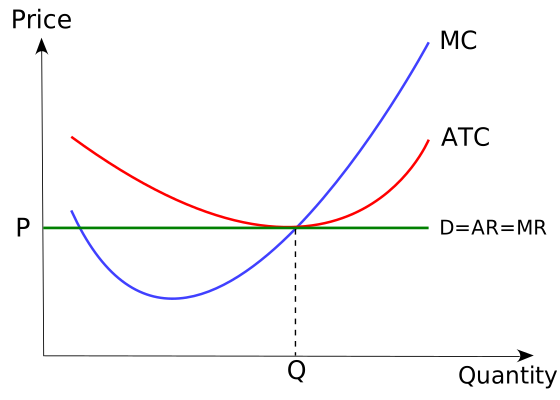
Perfect Competition: In a perfectly competitive market, the marginal revenue curve is horizontal and equal to demand, or price. Production occurs where marginal cost and marginal revenue intersect.
Monopoly Profit Maximization
The marginal toll curves faced by monopolies are similar to those faced by perfectly competitive firms. Most will have low marginal costs at low levels of product, reflecting the fact that firms can take advantage of efficiency opportunities as they begin to grow. Marginal costs get higher as output increases. For example, a pizza eatery tin can easily double production from one pizza per hour to two without hiring additional employees or buying more sophisticated equipment. When production reaches 50 pizzas per hour, still, it may be difficult to abound without investing a lot of money in more skilled employees or more loftier-tech ovens. This trend is reflected in the upward-sloping portion of the marginal price curve.
The marginal revenue bend for monopolies, however, is quite dissimilar than the marginal acquirement bend for competitive firms. While competitive firms experience marginal acquirement that is equal to cost – represented graphically by a horizontal line – monopolies have downward-sloping marginal revenue curves that are different than the skillful'southward price.
Profit Maximization Function for Monopolies
Monopolies gear up marginal cost equal to marginal revenue in order to maximize profit.
Learning Objectives
Explicate the monopolist's profit maximization function
Key Takeaways
Central Points
- The kickoff-order condition for maximizing profits in a monopoly is 0=∂q=p(q)+qp′(q)−c′(q), where q = the turn a profit-maximizing quantity.
- A monopoly'south profits are represented by π=p(q)q−c(q), where revenue = pq and cost = c.
- Monopolies have the power to limit output, thus charging a higher price than would be possible in competitive markets.
Key Terms
- first-club status: A mathematical relationship that is necessary for a quantity to be maximized or minimized.
- deadweight loss: A loss of economic efficiency that can occur when an equilibrium is not Pareto optimal.
Monopolies have much more than power than firms unremarkably would in competitive markets, but they still face limits determined past demand for a product. Higher prices (except under the most extreme weather) mean lower sales. Therefore, monopolies must make a decision about where to set their price and the quantity of their supply to maximize profits. They can either cull their price, or they can choose the quantity that they will produce and allow marketplace demand to set the price.
Since costs are a function of quantity, the formula for turn a profit maximization is written in terms of quantity rather than in price. The monopoly's profits are given by the following equation:
π=p(q)q−c(q)
In this formula, p(q) is the price level at quantity q. The cost to the house at quantity q is equal to c(q). Profits are represented by π. Since revenue is represented by pq and cost is c, profit is the divergence between these ii numbers. As a result, the outset-order condition for maximizing profits at quantity q is represented past:
0=∂q=p(q)+qp′(q)−c′(q)
The above first-order status must always be true if the firm is maximizing its profit – that is, if p(q)+qp′(q)−c′(q) is not equal to zero, then the firm tin can modify its price or quantity and brand more profit.
Marginal acquirement is calculated past p(q)+qp′(q), which is derived from the term for revenue, pq. The term c′(q) is marginal cost, which is the derivative of c(q). Monopolies will produce at quantity q where marginal revenue equals marginal cost. Then they will accuse the maximum toll p(q) that market demand volition respond to at that quantity.
Consider the example of a monopoly business firm that can produce widgets at a cost given by the following function:
c(q)=2+3q+qtwo
If the firm produces two widgets, for case, the total price is ii+three(2)+iiii=12. The price of widgets is determined by demand:
p(q)=24-2p
When the firm produces two widgets it can charge a cost of 24-ii(2)=20 for each widget. The firm's profit, equally shown to a higher place, is equal to the difference between the quantity produces multiplied by the price, and the total cost of production: p(q)q−c(q). How can we maximize this function?
Using the beginning guild condition, we know that when profit is maximized, 0=p(q)+qp′(q)−c′(q). In this case:
0=(24-2p)+q(-2)-(iii+2q)=21-6q
Rearranging the equation shows that q=3.five. This is the turn a profit maximizing quantity of production.
Consider the diagram illustrating monopoly competition. The key points of this diagram are fivefold.
- Showtime, marginal revenue lies below the demand bend. This occurs because marginal revenue is the demand, p(q), plus a negative number.
- 2d, the monopoly quantity equates marginal revenue and marginal price, merely the monopoly price is higher than the marginal cost.
- Third, there is a deadweight loss, for the same reason that taxes create a deadweight loss: The higher price of the monopoly prevents some units from being traded that are valued more highly than they cost.
- 4th, the monopoly profits from the increase in price, and the monopoly profit is illustrated.
- Fifth, since—under competitive conditions—supply equals marginal price, the intersection of marginal cost and demand corresponds to the competitive effect.
Nosotros see that the monopoly restricts output and charges a higher price than would prevail under competition.
Monopoly Diagram: This graph illustrates the toll and quantity of the market equilibrium under a monopoly.
Monopoly Product Decision
To maximize output, monopolies produce the quantity at which marginal supply is equal to marginal cost.
Learning Objectives
Explain how to identify the monopolist'due south production point
Key Takeaways
Key Points
- Unlike a competitive visitor, a monopoly tin can decrease product in order to charge a higher cost.
- Considering of this, rather than finding the point where the marginal cost curve intersects a horizontal marginal revenue bend (which is equivalent to skilful's price), we must find the point where the marginal cost curve intersect a downward-sloping marginal revenue curve.
- Monopolies take downward sloping need curves and down sloping marginal acquirement curves that have the aforementioned y-intercept as demand but which are twice as steep.
- The shape of the curves shows that marginal revenue will e'er be beneath need.
Key Terms
- marginal cost: The increase in cost that accompanies a unit of measurement increment in output; the partial derivative of the cost function with respect to output. Additional cost associated with producing 1 more than unit of output.
- marginal revenue: The boosted profit that will be generated by increasing production sales past one unit.
Monopoly Production
A pure monopoly has the aforementioned economic goal of perfectly competitive companies – to maximize profit. If we assume increasing marginal costs and exogenous input prices, the optimal decision for all firms is to equate the marginal cost and marginal revenue of production. Nonetheless, a pure monopoly can – unlike a house in a competitive market – alter the market price for its ain convenience: a decrease of product results in a higher toll. Considering of this, rather than finding the point where the marginal cost curve intersects a horizontal marginal acquirement curve (which is equivalent to good's toll), we must observe the signal where the marginal price curve intersect a downwardly-sloping marginal revenue curve.
Monopoly Product Point
Like non-monopolies, monopolists will produce the at the quantity such that marginal revenue (MR) equals marginal cost (MC). Even so, monopolists accept the power to modify the marketplace price based on the amount they produce since they are the only source of products in the market. When a monopolist produces the quantity determined by the intersection of MR and MC, it can charge the price determined by the market demand bend at the quantity. Therefore, monopolists produce less but accuse more than a firm in a competitive marketplace.
Monopoly Product: Monopolies produce at the betoken where marginal revenue equals marginal costs, but charge the cost expressed on the market place demand curve for that quantity of production.
In short, iii steps tin determine a monopoly firm's profit-maximizing price and output:
- Calculate and graph the business firm's marginal revenue, marginal cost, and need curves
- Identify the indicate at which the marginal revenue and marginal cost curves intersect and determine the level of output at that point
- Utilize the demand bend to discover the price that tin be charged at that level of output
Monopoly Price and Profit
Monopolies tin can influence a adept'south price by irresolute output levels, which allows them to make an economic profit.
Learning Objectives
Analyze the final price and resulting turn a profit for a monopolist
Key Takeaways
Cardinal Points
- Typically a monopoly selects a higher toll and lesser quantity of output than a price-taking company.
- A monopoly, unlike a perfectly competitive firm, has the market all to itself and faces the downward-sloping market demand curve.
- Graphically, one tin can find a monopoly's price, output, and turn a profit past examining the demand, marginal cost, and marginal revenue curves.
Key Terms
- economic profit: The difference between the full revenue received by the firm from its sales and the total opportunity costs of all the resource used by the firm.
- demand: The desire to buy appurtenances and services.
Monopolies, unlike perfectly competitive firms, are able to influence the price of a good and are able to make a positive economic profit. While a perfectly competitive firm faces a single market cost, represented past a horizontal demand/marginal revenue curve, a monopoly has the market all to itself and faces the downwards-sloping market demand curve. An important consequence is worth noticing: typically a monopoly selects a higher price and lesser quantity of output than a toll-taking company; again, less is available at a college cost.
Imagine that the market demand for widgets is Q=30-2P. This says that when the price is one, the market will need 28 widgets; when the price is two, the market volition need 26 widgets; and and so on. The monopoly'southward total acquirement is equal to the price of the widget multiplied past the quantity sold: P(30-2P). This can also be rearranged so that it is written in terms of quantity: full revenue equals Q(30-Q)/2.
The firm can produce widgets at a full cost of 2Qtwo, that is, it tin produce ane widget for $2, two widgets for $8, three widgets for $xviii, and so on. We know that all firms maximize profit past setting marginal costs equal to marginal acquirement. Finding this bespeak requires taking the derivative of total revenue and total cost in terms of quantity and setting the 2 derivatives equal to each other. In this case:
[latex]\frac{dTR}{dQ}=\frac{(30-2Q)}{ii}[/latex]
[latex]\frac{dTC}{dQ} =4Q[/latex]
Setting these equal to each other: [latex]fifteen-Q=4Q[/latex]
And so the turn a profit maximizing bespeak occurs when Q=iii.
At this point, the price of widgets is $13.l, the monopoly's total revenue is $40.50, the total cost is $18, and profit is $22.50. For comparison, it is easy to see that if the firm produced two widgets price would be $xiv and profit would be $20; if it produced four widgets price would exist $13 and profit would again be $20. Q=iii must exist the profit-maximizing output for the monopoly.
Graphically, one can find a monopoly's cost, output, and profit past examining the demand, marginal cost, and marginal revenue curves. Again, the firm will always set output at a level at which marginal cost equals marginal revenue, so the quantity is found where these two curves intersect. Price, however, is determined by the demand for the good when that quantity is produced. Because a monopoly's marginal acquirement is always below the need curve, the toll will always be above the marginal toll at equilibrium, providing the firm with an economical profit.
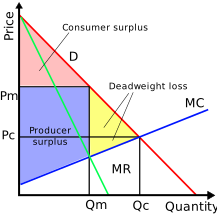
Monopoly Pricing: Monopolies create prices that are college, and output that is lower, than perfectly competitive firms. This causes economic inefficiency.
fitzgeralddarry1958.blogspot.com
Source: https://courses.lumenlearning.com/boundless-economics/chapter/monopoly-production-and-pricing-decisions-and-profit-outcome/
0 Response to "Review the Graph at Right for a Monopoly Market"
Post a Comment